More signals do not automatically create more clarity during a time-sensitive workflow.
Clinical decision support for the time-critical window
Earlier insight. Smarter prioritization. Better sepsis response.
SEPTR helps care teams move from a crowded field of alerts toward a clearer view of which patients may need attention first—and why.
Retrospective validation complete. Advancing external and prospective evaluation.
Designed around prioritization
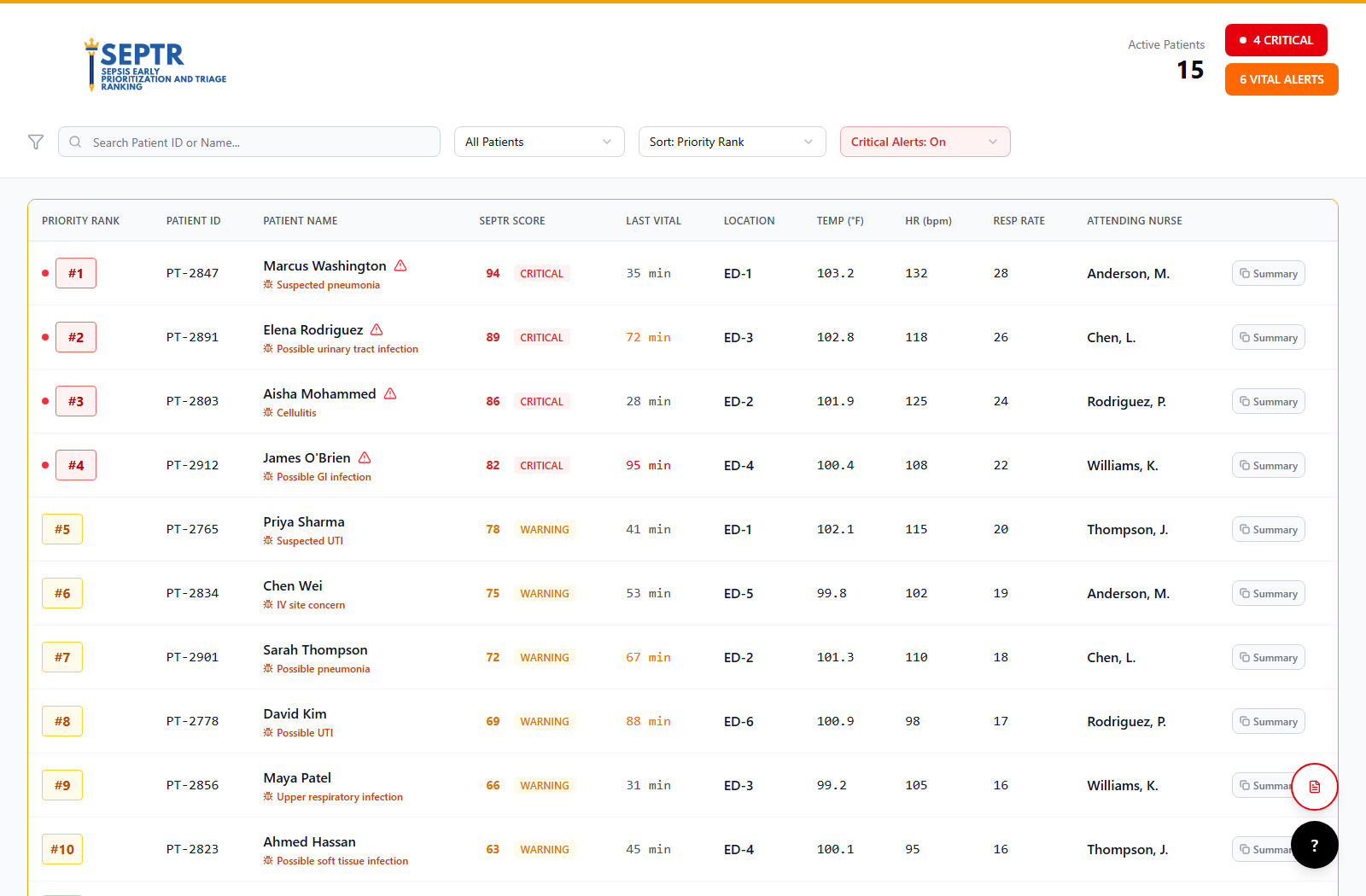
Ranked risk, recent vitals, location, and care context remain visible in one clinical view.
The operational challengeSignal volumeAlerts compete for finite attention. Clinical changeRisk is dynamic, not a snapshot. Workflow realityContext determines what comes next.
Sepsis is not only a detection problem. It is a prioritization problem.
Teams already manage signals from many sources. The harder question is how to interpret changing risk across a full patient population without losing the context needed for action.
A patient’s position can shift as physiology, documentation, and available data change.
Teams need concise reasons to investigate—not another disconnected score.
The SEPTR approach
A decision-support experience built around three essential jobs.
SEPTR brings together patient-level risk signals and workflow context in a ranked interface designed to support clinical review. It is intended to strengthen—not replace—professional judgment.
Recognition
Surface patterns that may warrant a closer look as available information changes.
Prioritization
Organize attention around a dynamic, patient-level view of relative urgency.
Clinical context
Keep supporting indicators visible so teams can review the reason behind a rank.
How it works
From changing data to a focused clinical review.
Observe
Available clinical data enters the decision-support workflow.
Assess
Patient-level patterns are evaluated as information changes.
Prioritize
The patient list is organized to support attention management.
Review
Clinicians inspect context and follow their established care protocols.
Product walkthrough
A shared view of who may need attention—and the context behind it.
The interface keeps priority rank, patient identifiers, score, last-vital timing, location, vital signs, and care ownership in one scan-friendly view.
Ranked patient list
Focus attention across a full care population.
Visible clinical context
Review supporting observations without leaving the queue.
Workflow controls
Search, filter, and sort for the task at hand.
Evidence pathway
Validation is a process, not a finish line.
We evaluate both technical performance and clinical usefulness, with attention to calibration, false positives, lead time, missingness, performance over time, and workflow utility.
Complete
Retrospective validation
Initial retrospective evaluation has been completed.
Advancing
External validation
We are pursuing evaluation across additional data and care settings.
Pathway
Prospective evaluation
Prospective study design will examine real-world workflow utility and performance.
Hospital value
Designed for the realities of care delivery.
SEPTR’s value is grounded in helping the right people form a clearer shared picture during a demanding clinical workflow.
01
Attention management
Support review across many patients without flattening urgency into a single alert stream.
02
Shared situational awareness
Give clinical and operational teams a common, current view of patient priority.
03
Evaluation-ready thinking
Frame adoption around measurable workflow questions and transparent evidence development.